The Old Jewish Quarter, Kraków
It’s early Sunday morning as I peer down into Plac Wolnica. Overhead grey skies are cracking apart and promising a fine day. A school group huddles in one corner taking pictures of the exterior of the Ethnographic Museum with their phones. Middle-aged couples wearing precautionary rain jackets and backpacks large enough to possibly contain an even more precautionary kitchen sink set off across higgledy-piggledy paving slabs to explore the city.
Beneath the trees lining two sides of the square, takeaway drivers sit on benches, necks craned over their phones, bikes propped up next to them, yellow Glovo boxes by their feet. At the corner of the square two dozen electric scooters cluster together like a flock of confused, lime-green flamingos who aren’t sure how they ended up surrounded by cafés, bars and tourists.
I head down and out across the square as bright sunlight peels back the clouds. This is Kazimierz, the storied district of Kraków, sandwiched between the pristine tourist epicentre of Old Town to the north and the broad River Vistula to the south. It’s a perfect location from which to explore this very walkable city.
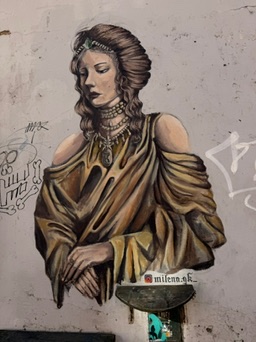
I head north through streets decorated with street art, graffiti and memorial plaques, where new boutique hotels sit next door to old places of worship and traditional pierogarnie neighbour vegan establishments. The restaurants and cafés are starting to wake up, the young staff carrying tables and dragging stacks of chairs onto pavements.
I arrive at Plac Nowy, the old market square at the centre of Jewish Kazimierz. It’s smaller than Plac Wolnica, with restaurants on all sides and it pivots around an old rotunda building. Today the rotunda is obscured by a dense agglomeration of market stalls piled high with pre-loved/second hand/vintage (please delete as you feel appropriate!) clothes and a smaller selection of antique ornaments and bric-a-brac stalls.
The market is already busy with locals, young and old, chatting animatedly and rooting through piles of clothes. Hangers scrape back and forth across rails. A dachshund weaves between shoppers’ legs. Plastic bags are stuffed with garments and złoty change hands. Sunlight glints off exceptionally ornate glassware. A breeze brings the scent of coffee and cooked meat and for a moment the sound of distant voices raised in song. I lose the sound as giggling adolescents brush past me.

I flick through a bin of old vinyl and wonder what Oddział Zamknięty’s 1985 album Reda by Night would sound like. The cover reveals a band with a look landing somewhere between Kajagoogoo and the Buzzcocks (with a stray moustache added from an unknown influence). They make me remember my own 1980s hair crimes, of both the scalp and top lip variety.
The next bin is stuffed with old postcards and, bizarrely, people’s personal photographs. Who were these young men in military jackets, chests puffed out glaring at the camera? Or this family huddled together in a small sitting room, beer bottles clustered on the plain table before them. Or this young woman in a summer dress, trees framing her slender limbs, the photo fading at the bottom, her legs a ghostly outline.
These silver-gelatin rectangles of history and mystery — now thumbed by strangers at a Sunday flea market — are an uncomfortable reminder of what Kazimierz holds beneath its atmospheric surface. These were real lives, lived on these streets, before history arrived and took everything. Someone kept these photographs once. Now nobody knows whose they are.
As I continue my journey through the photographic lives of others, the breeze again brings me the sound of singing. Dozens, if not more, voices raised in unison. This time I follow the sound, moving quickly across the district.
I pass Hevre, a popular café and bar housed in a former 19th-century Jewish prayer house. The previous evening, I enjoyed an excellent cocktail amidst its atmospheric environs. High windows, a picturesque balcony where couples bent close to whisper, long wooden tables, walls still adorned by the remnants of biblical frescoes and ornate original chandeliers. The cheery young staff waltzed through the crowded space serving cocktails and frothy pints to the sounds of 1980s British electro pop.
But today, the strange coexistence of tourists’ night-time revelry sitting alongside such dark history unsettles me. Such is the sense of history here that it is easy to slice through last night’s memories and imagine the horror of 1941 when the occupying Germans forcibly relocated Jews from the streets I am passing through to the Podgórze Ghetto. Had they been dragged from the building where I had been drinking and making jokes about The Inbetweeners last night? Most Jews relocated would die during the subsequent liquidation of the ghetto or in the Nazi death camps. Had any of the people in the photographs that I had flicked through earlier lived through that horror?
I stride on, following the singing. It’s much louder now. Maybe a street away. I glance into a shop selling art, a framed picture of the Schindler’s List movie poster in the window. There is a certain karma in a movie remembering and honouring those who suffered and died being the catalyst for Kazimierz’s regeneration. For that is exactly what happened. The huge, global success of the film led to a tourism boom, with visitors hungry to follow the story of Schindler, the ghetto and to explore the atmospheric streets. The money this brought in was used to redevelop the district, encouraging more tourism and so the cycle goes.
I turn a corner and, at the end of a short street, see people on the pavement watching a procession. I see flashes of deep purples, red, white and black. Sunlight glints off something golden held high. I join the watchers and the amplified singing engulfs me. It is Eucharistic and Marian hymns sung by hundreds of voices as a huge Catholic procession passes by.
Priests and deacons wearing white and brown cassocks carry sunburst monstrances containing the Blessed Sacrament on flower-adorned litters. Women in white blouses and black skirts dutifully carry effigies. A lone man sweating through a grey business suit, hands squeezed together before him, an old lady in a red coat and sunglasses, her arms sagging beneath the weight of a smaller monstrance, nuns and others in uniforms that I do not know, all part of this slow river of humanity.

Next to me, a woman drops to her knees and mutters prayers. Others follow her pious example. On a first-floor balcony, on the opposite side of the road, an old man has draped the Polish flag and a picture of the Madonna over the railing. He applauds the procession, then tiredly slumps into a chair in the shade.
These grand Catholic processions have been taking place in Poland for over 700 years. I am watching living history pass by and like so many others I am compelled by the modern urge to raise my phone and capture it for the digital world. I click and zoom and click again. Photographs that will never end up on a flea market stall with a tourist flipping through them pondering the lives of others.