Thirteen years, one mosque, and the one thing the travel industry cannot sell you
Our guide, Mohammed, a confident young Libyan, who has been spraying facts and opinions with the certainty of youth since our tour began, marches us out onto the lush and ornate carpet of the mosque’s main prayer hall. He invites us to sit. For the first time in forty-five minutes his information torrent is dammed as he too surveys the magnificence of our surroundings.
There are perhaps only another thirty people sharing the carpet with us. And, as this is the world’s largest hand-woven carpet, that leaves plenty of space. I’m free to stand and wander around, marvelling at the size of the chandeliers that cascade in glittering layers, and to stroke intricate mother-of-pearl patterns inlaid across the ninety-six columns that support the roof and the eighty-two domes. The year is 2013, and the location is Abu Dhabi’s Sheikh Zayed Grand Mosque.
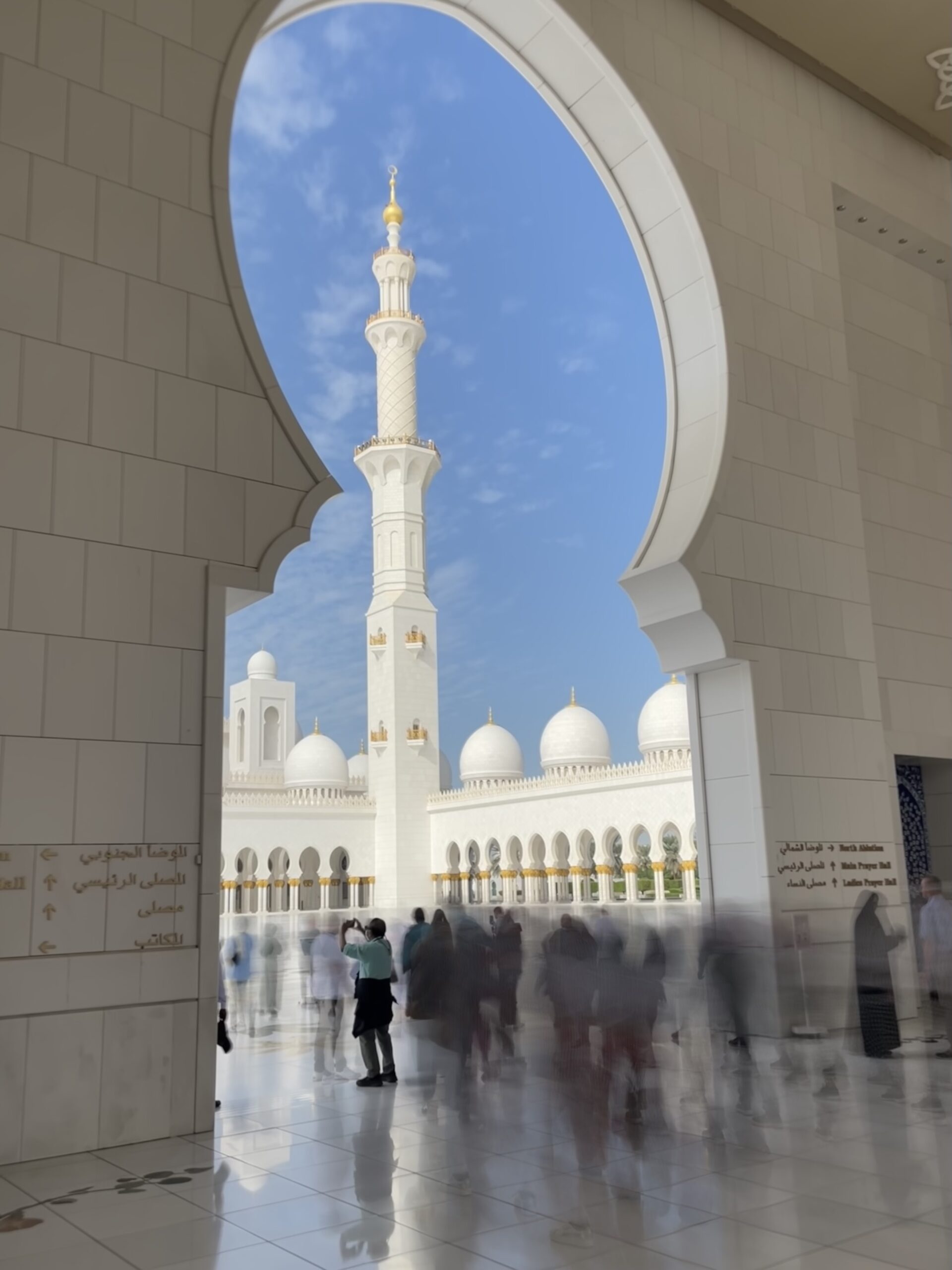
If I fast-forward thirteen years to my next visit, the experience is much changed. A taxi drops me at the mosque’s official car park some distance from the building. Entrance is now via a pedestrian tunnel, lined with retail opportunities, that runs beneath the car park to emerge at the mosque. I can no longer access the main prayer hall. Visitors must walk the perimeter, and whenever an archway offers a glimpse of the interior, a scrum of bodies clogs the orifice, phones raised high to capture an image of the finery, or the back of somebody’s head.
In 2013, Abu Dhabi hadn’t hit its stride as a tourism destination and was still very much in Dubai’s shadow. Thirteen years later, following the laser-focused planning of its leaders, it is a confident destination with world-class cultural attractions and entirely new districts to explore. Tour operators have it packaged on websites and in brochures, and content makers (professional and amateur) have mapped out the highlights in images across social media.

Some would argue that this is modern tourism in action: the great devourer of authenticity, the commoditiser. But is this true? And if it is, is it even desirable or possible for tourism to avoid this outcome? After all, it was tour operators’ marketing of ‘authenticity’ that created the demand. And when the industry found it couldn’t deliver this at scale, it continued selling the next best thing.
My experience has taught me the hard lessons of tour operating at scale, and the need to balance a client’s desire for authentic, unique experiences with high standards of accommodation and food, insightful and courteous guides, and frictionless transportation from the moment they arrive in country.
To build the products needed to fulfil these needs, tour operators must contract with destinations and suppliers who understand and respect the tour operators’ business model: high accommodation and food standards, health and safety compliance, data protection and sustainability, amongst myriad other considerations that are all vital to the tour operator.
The effort to add a product, or an entire destination, that hasn’t worked with this model before can be prohibitively time-consuming, and as a result, tour operators focus on the market-ready products and destinations where competitors are already established. Itineraries, with small variations, are repeated across the market, creating ‘circuits’, and the destinations and suppliers, and all the supporting businesses, along these circuits adjust to accommodate the volume of tourism they are serving.
The same ‘circuit’ effect is seen with independent travellers. Basing decisions on reviews and social media posts that are ranked for popularity by algorithms leads travellers to stay in the same ‘unique’ hotels and to seek out the same ‘unique’ experiences, and to chase down the same ‘iconic’ photographs. In time, this changes the nature of the authentic experiences the traveller seeks, as the destination adjusts to the volumes flowing through and the expectations the travellers bring with them.
The immediacy and reach of social media can trigger this phenomenon at speed. An extreme example of this was the change that overtook Kyoto’s Gion District, with tourists stalking geiko, tearing their kimono, even dropping a cigarette butt down a collar, just so they could take a photograph. This resulted in photography being banned on private roads in 2019, and then tourists themselves being banned from the same roads in 2024. Both restrictions are highlighted with multilingual signs and enforced with fines.


I challenged myself to think of the most authentic journey I have taken outside the UK and came up with a post-university trip to the USA during which I hitchhiked from Niagara Falls to New Orleans with my mate Sid, one of the most intense and life-affirming fortnights of my life.
It included everything sleeping rough outside churches and by the roadside; being taken home for dinner by a family (“Get Simon a glass for his beer. The English drink beer from a glass, not a bottle”); nearly crashing into the central reservation somewhere in Virginia while being given a lift by a stoner good old boy with a rifle sitting next to me in the back and a deer in the boot; riding with a repo man on the way to repossess a car from a grandma; juddering down the highway in a stinking fish truck; being picked up by an ex-baseball player who bought us a tent, bread and ham, a case of beer, national park permits, and set us off walking the Appalachian Trail, and much more.
Not an itinerary you could replicate with a tour operator. In fact, not an itinerary that anybody could replicate – other than Fate.
So, if we accept that mainstream tourism is structurally incapable of delivering authenticity, the question is, does this matter to clients and to the communities that these tourism circuits co-opt?
The reason UK tour operators make the demands of the suppliers that they do is two-fold: first, legal requirements under the Package Travel and Linked Travel Arrangements Regulations 2018, and second, client expectation. Most clients want authenticity, but they want it to come with comfort and safety, excellent meals, flawless logistics and the certainty that their email details won’t be used for a phishing attack when they return home. In short, they want authenticity on their terms. A tourist-friendly simulacrum of authenticity.
What exactly does this mean for communities? While, in most cases, they will derive some economic benefits as part of a tour operator circuit, this positive comes with heavy caveats. Sri Lanka, one of my favourite countries to travel in, with its wonderful people, wildlife experiences, rich and historically complex culture, is a prime example, and one I saw first hand during my time in the industry.

One classic route, taking in Colombo or Negombo, the Cultural Triangle, Kandy, Tea Country and a safari, has come to dominate mass tourism across a relatively brief high season of December to March. Sri Lanka was a major market for the company I worked for, so we put all our effort into maximising sales for this period, leading to wildly uneven demand for the country. In this peak season, excessive pressure comes to bear on hotels, affecting both staff and clients; large queues of safari vehicles form in the national parks, leading to unsatisfactory viewing experiences; major attractions like Sigiriya are crammed with visitors and, tickets for the Kandy to Ella scenic train (popularised on social media) are almost impossible to secure. In the off-season, visitor numbers are low and guides and safari drivers are unemployed (unless kept on a retainer).
Sri Lanka has two weather seasons running opposite each other, with the key attraction of the Cultural Triangle sitting in a dry region, making it combinable with the east and north during their May to September dry season. The reality is the industry sells one quadrant of the country for four months, when Sri Lanka could be a year-round destination. Even the most community-focused, B-Corp-certified tour operators cannot avoid sanding away the edges of authenticity and affecting communities.
None of this means that authenticity doesn’t exist. It just can’t be booked. I recently travelled to Kuala Lumpur and made sure I researched authentic local restaurants (for authentic, read: long-established, ‘atmospheric’ and serving classic dishes), and there were many near my hotel.

However, during my exploration of the city, as I wilt from humidity that has sweat running down my sides, I take refuge in a mall and ride the lift to a food court in search of a drink. Here I encounter a scene probably much more authentic than the restaurants I had researched: hundreds of young Malaysians loudly chatting, bent over phones, sucking on tall juices, laughing and joking while they queue at food stations. Loud Malaysian pop music plays over speakers. The escalator constantly delivers more diners to the food court from the shopping levels below. Chair legs squeak against linoleum as diners find seats and pull clothing from bags for their friends to admire.
Steam swirls up from a wok, and earthy aromas set my stomach rumbling. But I need fluid before food. The young woman making fruit juices wears a lime-coloured headscarf and a mask, so all I can see of her face is her dark eyes. Her name badge reads Aisyah. She looks bored and a little miserable. When I thank her for my drink in my clumsy Malay – terima kasih – I see amusement as her eyes narrow and the mask crinkles under her smile. It’s a small, unrepeatable, entirely authentic exchange. But I don’t know what Aisyah is thinking, or what her day has been like. I have made her an anecdote.
If we accept that authenticity is not a product, then I don’t think the tourism industry should feel guilty about a lack of true authenticity in their offering; this is structural and inevitable. However, the impact they have on communities, this sanding away of authenticity, is undeniably their responsibility.
In my mind, I return to the Sheikh Zayed Grand Mosque in 2026. I stand in that people-clogged marble archway and raise my phone like everybody else. A dozen weaving snake arms, hunting the best image. I huff and groan, remembering my experience from thirteen years before, when, unrestrained by barriers, I sat cross-legged on the lush carpet beneath twinkling chandeliers. Back when it was better, more authentic.
But my visit in 2013 was no more authentic; it was just a question of timing.
I take my picture. A beautiful arch, the chandelier beyond and somebody’s burnt bald pate. I lower my phone.
Postscript… (#1)
Fact: A Writer’s World, Travels 1950-2000 by Jan Morris: A compilation of around 100 evocative articles by one of the great travel writers. “These were my own responses, anyway, my own conceptions of my own zeitgeist. This is how I felt about my world.”
Fiction: The Beach by Alex Garland: It’s hard not to think of this novel (and the film it spawned) as a self-fulfilling prophecy. People find paradise, people tell other people about paradise, paradise is slowly destroyed.
Postscript… (#2)
My epic hitch-hiking trip from Niagara Falls to New Orleans isn’t a trip I would undertake again, unless – shameless pitch – a publisher wants to commission me to re-hitchhike the route and write a book of comparative experiences… just saying.