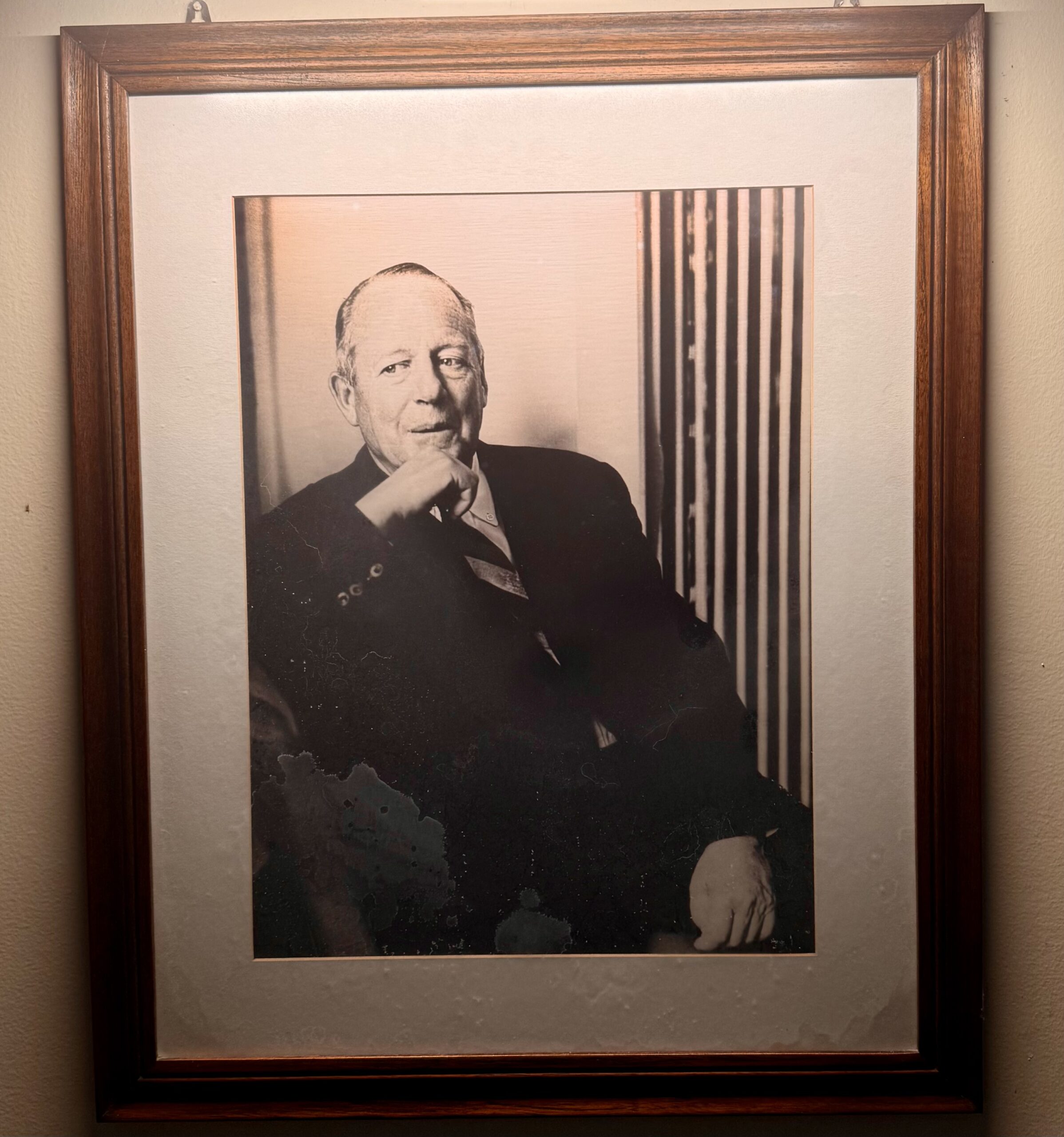
The Silk King of Thailand vanished into these hills in 1967 — my guide has a different story.
(Cameron Highlands Resort, Cameron Highlands, Malaysia)
“So,” I say. “Tell me, what really happened to Jim Thompson?”
Madi, the naturalist from the Cameron Highlands Resort, is my guide for this morning’s hike along his self-devised Jim Thompson Trail. He’s a sprightly seventy-two and has worked for the resort for fourteen years. He wears John Lennon round sunglasses, a wide-brimmed hat and ranger-style khakis. He carries a bamboo walking stick gifted to him by the indigenous Orang Asli on whose behalf he advocates. He has been using it to point to the flora and fauna of this rich rainforest environment.
Madi taps the stick against his boot. “Let’s walk a little more. Then I will tell you.”
The hotel’s promotional literature leans heavily into the official story: at some time between 3pm and 4pm on Easter Sunday, 26th March 1967, Jim Thompson – the ‘Silk King of Thailand’ and former OSS officer – set out for an afternoon walk from Moonlight Cottage, on the hill above where the Cameron Highlands Resort now sits. He was seen by the cook of the neighbouring Lutheran Mission bungalow, then descended a familiar path into the forest. He was never seen again.
Madi grew up here, and was a child when Thompson disappeared. As part of the tour, he will share the accounts of those adults who were witness to that day. When I spoke to him the previous day, he hinted his version may not match the official version and I am intrigued.


But the first part of the hike is focused on the natural beauty of the dense forest below Moonlight Cottage. We enter low down the hill and slowly climb the narrow, overgrown path, the volume of birdsong rising the closer we come to the canopy. We are joined by an American couple living in Singapore and their two young children, who gamely navigate the terrain.
“Are there tigers down there?” says the youngest of the children squinting down a forest trail that makes a T-junction with ours.
Madi shakes his head. “No tigers. That is the path Jim Thompson took down from Moonlight Cottage on the day he disappeared.”
The boy looks crestfallen at the absence of a man-eating predator and plods on in search of alternative deadly fauna. I stare down the path trying to imagine Jim Thompson on the trail, swinging a cane to cut away obstructing branches, the receding hairline and tanned face, intense stare and lined forehead. His ghost passes through me, onwards down the trail to whatever fate awaits him.
Madi lets the rest of the group forge ahead a little and puts a hand on my shoulder. He points to the faintest of trails climbing away from us to the right.
“That is a tiger trail,” he says and raises his eyebrows. “Malayan tiger. Big one. Don’t worry, it only visits us in June to August.”
I am grateful that we are here in a reassuringly distant March, but I still find myself with heightened senses for the next few minutes as we climb higher; the loamy smell of the soil, the slender trickle of a stream, the snap and pop of branches as we follow the trail and begin to arc back down the hill.
The forest is wonderfully pristine, intensely green. Occasional sunbeams pierce the canopy, landing spotlights onto this emerald stage. Native palm trees spread wide their metallic-green leaves, elbowing aside fat-stemmed elephant ferns and lace-like peacock ferns. Amidst these bruisers the most delicate of lichens reach out from branches. Tying all these competing greeneries together are looping and swaying vines that Tarzan between the trees and velvety moss, hanging carpet-like between branches, thick enough underfoot to take an adult’s weight.


I am sad to leave the forest, but our tour takes us onto a broad road that slopes down towards the main road and the hotel. Madi stops. “You want to know what happened to Jim Thompson?” he asks us.
“Yes,” we chorus.
He smiles his mischievous smile. “Jim Thompson didn’t disappear in the forest. People I have spoken to saw him leave the forest just where we have and then he walked down the road to that junction…” he pivots and points to a fork in the road twenty metres away. “Where he was met by a Cadillac. Inside the car were British soldiers. He climbed inside and was driven away. Other people saw the Cadillac arrive in Tanah Rata where it met a waiting helicopter. Jim Thompson climbed into the helicopter and it took off. That was when he disappeared.”
Madi pauses, looking from face to face. “You going to ask why, aren’t you?”
I nod as I watch the ghost of Jim Thompson walk away from me and then fade away as he reaches the junction.
“That I don’t know. I can only speculate based on the known facts. But I think it is linked to the silk business he built in Thailand at the height of the Cold War. It’s accepted that he was a wartime officer in the OSS, the forerunner of the CIA, and some have suggested that his business was a front for moving weapons up the Chao Phraya River to anti-communist forces in the Golden Triangle.”
He continues to explain that after Thompson’s disappearance, Thai and Japanese gangsters scoured the Cameron Highlands looking for him. Had his silk business been a threat to the Japanese silk interests of the Yakuza? Madi can offer no definitive answer.
We continue back down the road towards the hotel, the story playing out in my mind and the road ahead of me where I imagine a black Cadillac rolling down the hill, the road rougher than the one we follow today. I see Thompson sitting next to a square-shouldered soldier in the back of the vehicle, twisting around for one last glance at his beloved highlands.
Further down the road we pass another junction and a signpost for Moonlight Cottage. Madi tells me the building is now in local ownership, its once-beautiful gardens tarmacked over, its interior crudely subdivided into boxy rooms. This piece of history has been erased in all but name.
Back at the hotel I offer Madi warm thanks for the excellent hike and fascinating history. Modest as ever, he shakes my hand with a gentle grip and says that he is pleased that I enjoyed it. He strides off for a break, his stick clacking against the tarmac. In the afternoon he has a different tour to lead, different stories to tell.
Later, sitting in the hotel’s bar, I raise my gin and tonic to Madi, the ‘Silk King of Thailand’ and this enduring mystery. The gin is icy cold and the quinine tastes particularly astringent in the cool evening air flowing in through an open window.
Can we be sure the stories of that day recounted to Madi were true? People make up stories for all sorts of reasons, they misremember facts and faces, and time’s gravity makes history’s pigments bleed together.
What if there was an altogether different explanation for his disappearance? One rooted in the wilderness surrounding the cottage. Perhaps the key to the mystery is a hungry Malayan tiger making an out-of-season stop in the Cameron Highlands, not the machinations of Cold War espionage.
I think I’ll need another gin and tonic to work on my theory.

Postscript…
Fact: Jim Thompson: The Unsolved Mystery by William Warren. The definitive account of the Silk King’s life and disappearance, written by someone who knew him. Warren weighs every theory Madi didn’t mention, and a few he did, without ever quite closing the case. Nobody has.
Fiction: The Garden of Evening Mists by Tan Twan Eng. Set in the Cameron Highlands themselves — the tea slopes, the jungle, the ghosts of the Emergency. A Booker-shortlisted exploration of what these hills remember.