“A £37 scallop, two-and-a-half miles of corridors, and a building that swapped one kind of secrecy for another.”
(Paper Moon Restaurant, Raffles Hotel at The OWO, Whitehall, London)
The Old War Office’s entrance, polished wood and clear glass, smoothly delivers me into a high-ceilinged, Baroque marble lobby. I crane my neck skywards. A spectacular domed skylight illuminates a chandelier of audacious pomp. Beneath this, a grand staircase, carpeted in blood red, rises into the light before splitting and arriving at a balcony.
The hotel will tell you that it’s from this vantage point that Winston Churchill would address his War Office staff during his time as Secretary of State for War. I imagine those iconic reedy tones bouncing off the marble walls to rousing effect, echoing through the building’s two-and-a-half miles of corridors.
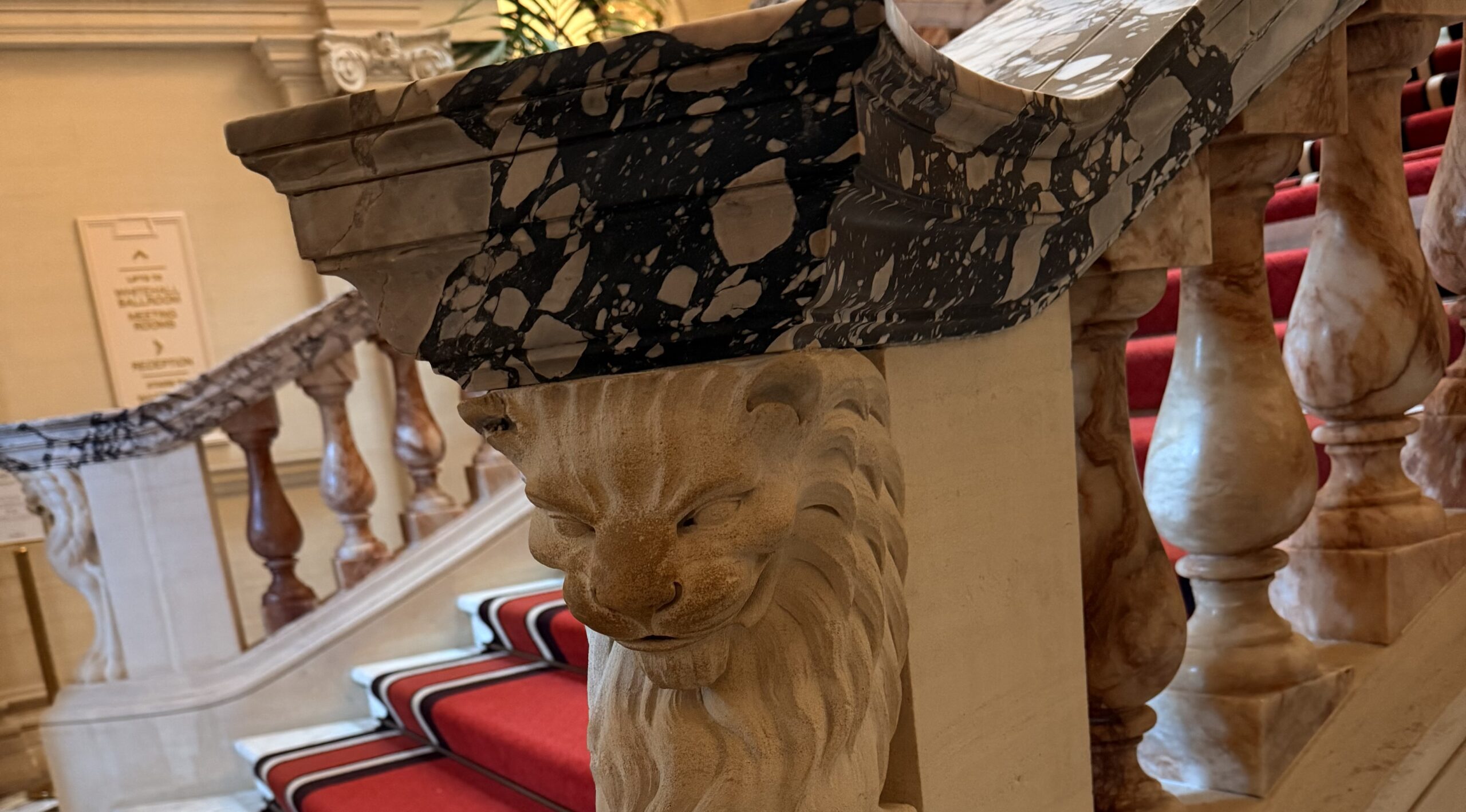
I pause at the bottom of the stairs to inspect a lion’s face carved into the marble balustrade. Legend has it that Churchill would rub the lion’s nose for good luck when he passed. If he didn’t, everybody else since must have, as the poor creature’s nose is darkened by the grease of untold fingers. I can’t resist adding my own, even as I realise I am both following the legend and, in writing this, feeding it.
I leave the lobby and stroll down a long corridor that opens onto wood-panelled cafés and bars to finally arrive at Paper Moon restaurant. The Old War Office reopened as Raffles London at The OWO in 2023, after a six-year renovation. Paper Moon is one of the hotel’s nine restaurants.
Two of my three dining companions have already arrived. The maître d’, suit and shirt as crisp as the table linen, Stanley Tucci glasses perched on the bridge of his nose, unfurls my napkin with a flourish and lays it on my lap. He asks if, on arrival, our final guest will be drinking still or sparkling water. When I reply “wine”, my clunky gag is met with the most enthusiastic of laughs.
When the last member of our group arrives, we order wine and clink glasses. After I order my starter and main course, and am effusively congratulated on my choices, the waitress returns to exchange my cutlery. Knives and forks are replaced with the flowing movements of a tai chi master; first she lowers them on the table a safe distance from me, before gliding them closer with a fluid motion. I can almost hear stainless steel whispering against the linen tablecloth.

Such performative levels of guest service are to be expected at a fine-dining restaurant housed in one of London’s most luxurious hotels, where the Noci di Capesante (pan-seared scallops with Jerusalem artichoke cream, sea urchin sauce and fennel chips), a delicious antipasto, costs £37.
However, such performance seems surreal when considering the rich history attached to the former Old War Office building in which we are dining. Where I struggle to decide between the Pappardelle Paper Moon and Filetto di Manzo for my main course, decisions on the life and death of millions were made in these rooms during both the First and Second World Wars, and many of the 20th century’s pivotal events were shaped by the secretive meetings within its walls. What isn’t a secret is that I choose Pappardelle Paper Moon as my main, plump ribbons of pasta with a creamy tomato sauce balanced with salty pancetta – it’s deceptively simple and delicious.
The walls are hung with photographs of movie stars, a direct inheritance from the original Paper Moon, established in 1977, when its elegant food quickly made it as the haunt of the city’s glitterati. That same year, six hundred miles north-west, the staff of the OWO were preoccupied with altogether darker thoughts than olive oil and pasta. Nuclear war and political instability would have dominated their menu, as the growing Soviet threat loured over Europe, and Callaghan’s government clung to power with the support of the Liberals.
But as I sit here inhaling the wonderful tomato and bacon aromas of my Pappardelle Paper Moon, I wonder what this bold act of reinvention means for the hotel and London. From my time in the industry, I remember The Liberty Hotel opening in Boston. This former prison was repurposed as a luxury hotel, while retaining many of the original features – it was a controversial opening with many feeling it trivialised incarceration and suffering. The Old War Office holds no equivalent suffering, only power, which is perhaps why the objections, when they came, were about ownership rather than taste. It is one of the greatest buildings of the Edwardian age and one of the most storied of the 20th century, has been saved from decline, but it is now a playground for the affluent global tourist.

The return of the waitress with our desserts saves me from further ruminations. It’s a deliciously creamy, eye-poppingly generous tiramisu served in a broad shallow bowl – one of the most decadent dishes I have eaten. My fellow diners cast envious glances towards my bowl. This is followed by a post-lunch espresso martini in the hotel’s Drawing Room bar, where creaking leather sofas are surrounded by wood-panelled walls and bookcases to create a luxuriant private club feel. Below us somewhere is a bar built in the building’s old MI5 rooms, open to hotel guests and invited visitors only. The secrecy is still here; it’s simply changed who it’s keeping out.
I exit the hotel onto Whitehall and breathe in hot summer air. Dandelion seeds float past me. I catch one and make a wish (that I have that tiramisu again, soon). Opposite me, a scrum of tourists raise their phones high to film the King’s Life Guard sitting stonily on their mounts.
One elderly man extricates himself from the throng and trains his camera on the OWO, panning slowly as he films. Does he know what he is filming? Does he see a luxury hotel, or a building of singular historical renown? Or does he see both, one layered over the other? Maybe it is the wine and the espresso martini, but what I see is a building that spent a century keeping secrets now hiding in plain sight as a hotel, and somehow that feels completely in character.

Postscript
Fact: A Spy Among Friends by Ben Macintyre. Kim Philby, the clubs of St James’s, and the gentlemanly Whitehall world that buildings like the Old War Office were built to house. Espionage history that reads like a thriller.
Fiction: Casino Royale by Ian Fleming. The building stood in for MI6 in three Bond films, and its domed towers have turned up in two more. Fleming spent the war in Naval Intelligence a short walk away and mined it for everything Bond became.

Leave a Reply